
| 1. Identification |
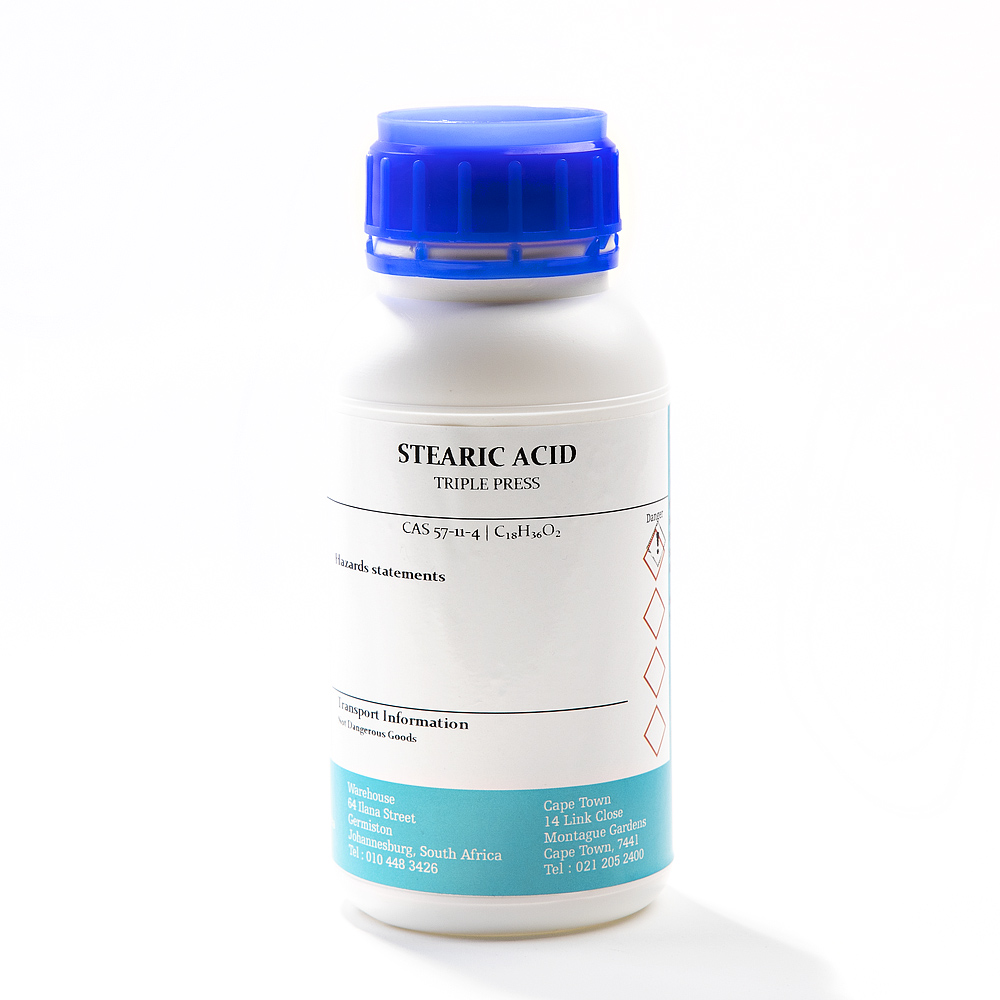
Product Name Stearic acid
CAS-No 57-11-4
Synonyms Octadecanoic acid
Recommended Use Laboratory chemicals.
Uses advised against Not for food, drug, pesticide or biocidal product use
Details of the supplier of the safety data sheet
Company
Rolfes Chemicals
Strachan Road
Germiston
Tel: 011 873 0157
Emergency Telephone Number
0860 44 44 11
| 2. Stearic Acid ��� Triple Press ��� Hazard(s) identification |
Classification
Classification under 2012 OSHA Hazard Communication Standard (29 CFR 1910.1200) This chemical is considered hazardous by the 2012 OSHA Hazard Communication Standard (29 CFR 1910.1200)
| Combustible dust Yes |
Label Elements
None required
Signal Word
Warning
Hazard Statements
May form combustible dust concentrations in air
| 3. Composition/Information on Ingredients |
| Component | CAS-No | Weight % |
| Stearic acid | 57-11-4 | >95 |
| 4. Stearic Acid ��� Triple Press ��� First-aid measures |
Eye Contact Rinse immediately with plenty of water, also under the eyelids, for at least 15 minutes. Get medical attention if symptoms occur.
Skin Contact Rinse with plenty of water. Get medical attention if symptoms occur.
Inhalation Move to fresh air. If breathing is difficult, give oxygen. Get medical attention if symptoms occur.
Stearic Acid
Ingestion Do not induce vomiting. Get medical attention if symptoms occur.
Most important symptoms and No information available.
effects
Notes to Physician Treat symptomatically
| 5. Fire-fighting measures |
Suitable Extinguishing Media Use water spray, alcohol-resistant foam, dry chemical or carbon dioxide. Unsuitable Extinguishing Media No information available
Flash Point 196 ��C / 384.8 ��F
Method ��� No information available
Autoignition Temperature 395 ��C / 743 ��F
Explosion Limits
Upper No data available
Lower No data available
Sensitivity to Mechanical Impact No information available
Sensitivity to Static Discharge No information available
Specific Hazards Arising from the Chemical
Fine dust dispersed in air may ignite. Dust can form an explosive mixture in air. Thermal decomposition can lead to release of irritating gases and vapors. Keep product and empty container away from heat and sources of ignition.
Hazardous Combustion Products
Carbon monoxide (CO) Carbon dioxide (CO2)
Protective Equipment and Precautions for Firefighters
As in any fire, wear self-contained breathing apparatus pressure-demand, MSHA/NIOSH (approved or equivalent) and full protective gear.
NFPA
Health Flammability Instability Physical hazards 1 1 0 N/A
Stearic Acid
| 6. Accidental release measures |
Personal Precautions Use personal protective equipment. Ensure adequate ventilation. Avoid dust formation. Avoid contact with skin, eyes and clothing.
Environmental Precautions Avoid release to the environment.
Methods for Containment and Clean Sweep up or vacuum up spillage and collect in suitable container for disposal. Avoid dust Up formation.
| 7. Stearic Acid ��� Triple Press ��� Handling and storage |
Handling Wear personal protective equipment. Ensure adequate ventilation. Avoid contact with skin, eyes and clothing. Avoid ingestion and inhalation. Avoid dust formation.
Storage Keep containers tightly closed in a dry, cool and well-ventilated place.
| 8. Exposure controls / personal protection |
Exposure Guidelines This product does not contain any hazardous materials with occupational exposure limitsestablished by the region specific regulatory bodies.
| Component | ACGIH TLV | OSHA PEL | NIOSH IDLH | Mexico OEL (TWA) |
| Stearic acid | TWA: 10 mg/m3
TWA: 3 mg/m3 |
Engineering Measures Ensure adequate ventilation, especially in confined areas. Ensure that eyewash stations and safety showers are close to the workstation location.
Personal Protective Equipment
Eye/face Protection Wear appropriate protective eyeglasses or chemical safety goggles as described by OSHA���s eye and face protection regulations in 29 CFR 1910.133 or European Standard
EN166.
Skin and body protection Wear appropriate protective gloves and clothing to prevent skin exposure.
Respiratory Protection Follow the OSHA respirator regulations found in 29 CFR 1910.134 or European Standard EN 149. Use a NIOSH/MSHA or European Standard EN 149 approved respirator if
exposure limits are exceeded or if irritation or other symptoms are experienced.
Hygiene Measures Handle in accordance with good industrial hygiene and safety practice.
| 9. Physical and chemical properties |
Physical State Solid
Appearance White
Odor No information available
Odor Threshold No information available
pH No information available
Melting Point/Range 67 ��� 69 ��C / 152.6 ��� 156.2 ��F
Boiling Point/Range 361 ��C / 681.8 ��F @ 760 mmHg
Flash Point 196 ��C / 384.8 ��F
Evaporation Rate Not applicable
Flammability (solid,gas) No information available
Flammability or explosive limits
Upper No data available
Lower No data available
Vapor Pressure 1 mmHg @ 174 ��C
Vapor Density Not applicable
Specific Gravity 0.840
Solubility
Partition coefficient; n-octanol/water Autoignition Temperature
Decomposition Temperature Viscosity
Molecular Formula
Molecular Weight
Reactive Hazard
Stability
Conditions to Avoid
Incompatible Materials
Stearic Acid
No information available
No data available 395 ��C
/ 743 ��F
No information
available Not applicable
C18 H36 O2
284.47
- Stability and reactivity None known, based on information
Hazardous Polymerization Hazardous Reactions
Acute Toxicity
available Stable under normal conditions.
Avoid dust formation. Incompatible products. Excess heat. Combustible material, Bases, Strong oxidizing agents, Reducing agents
Hazardous Decomposition Products Carbon monoxide (CO), Carbon dioxide (CO2) Hazardous polymerization does not occur.
None under normal processing.
| 11. Stearic Acid ��� Triple Press ��� Toxicological information |
Product Information
Component Information
| Component | LD50 Oral | LD50 Dermal | LC50 Inhalation |
| Stearic acid | LD50 = 4600 mg/kg ( Rat ) | LD50 > 5 g/kg ( Rabbit ) | Not listed |
Toxicologically Synergistic No information available
Products
Delayed and immediate effects as well as chronic effects from short and long-term exposure
Irritation No information available
Sensitization No information available
Carcinogenicity The table below indicates whether each agency has listed any ingredient as a carcinogen.
| Component | CAS-No | IARC | NTP | ACGIH | OSHA | Mexico |
| Stearic acid | 57-11-4 | Not listed | Not listed | Not listed | Not listed | Not listed |
Mutagenic Effects Mutagenic effects have occurred in humans.
Reproductive Effects No information available.
Developmental Effects No information available.
Teratogenicity No information available.
STOT ��� single exposure None known
STOT ��� repeated exposure None known
Aspiration hazard No information available
Symptoms / effects,both acute and No information available
delayed
Endocrine Disruptor Information
Stearic Acid
No information available
Other Adverse Effects The toxicological properties have not been fully investigated. See actual entry in RTECS for complete information.
Stearic Acid
| 12. Ecological information |
Ecotoxicity
Do not empty into drains.
Persistence and Degradability Soluble in water Persistence is unlikely based on information available. Bioaccumulation/ Accumulation No information available.
Mobility Will likely be mobile in the environment due to its water solubility.
| 13. Stearic Acid ��� Triple Press ��� Disposal considerations |
Waste Disposal Methods Chemical waste generators must determine whether a discarded chemical is classified as a hazardous waste. Chemical waste generators must also consult local, regional, and
national hazardous waste regulations to ensure complete and accurate classification.
| 14. Transport information |
DOT Not regulated
TDG Not regulated
IATA Not regulated
IMDG/IMO Not regulated
| 15. Regulatory information |
International Inventories
| Component | TSCA | DSL | NDSL | EINECS | ELINCS | NLP | PICCS | ENCS | AICS | IECSC | KECL |
| Stearic acid | X | X | ��� | 200-313-4 | ��� | X | X | X | X | X |
Legend:
X ��� Listed
E ��� Indicates a substance that is the subject of a Section 5(e) Consent order under TSCA.
F ��� Indicates a substance that is the subject of a Section 5(f) Rule under TSCA. N ��� Indicates a polymeric substance containing no free-radical initiator in its inventory name but is considered to cover the designated polymer made with any free-radical initiator regardless of the amount used. P ��� Indicates a commenced PMN substance
R ��� Indicates a substance that is the subject of a Section 6 risk management rule under TSCA.
S ��� Indicates a substance that is identified in a proposed or final Significant New Use Rule
T ��� Indicates a substance that is the subject of a Section 4 test rule under TSCA. XU ��� Indicates a substance exempt from reporting under the Inventory Update Rule, i.e. Partial Updating of the TSCA Inventory Data Base Production and Site Reports (40 CFR 710(B).
Y1 ��� Indicates an exempt polymer that has a number-average molecular weight of 1,000 or greater.
Y2 ��� Indicates an exempt polymer that is a polyester and is made only from reactants included in a specified list of low concern reactants that comprises one of the eligibility criteria for the exemption rule.
U.S. Federal Regulations
TSCA 12(b) Not applicable
SARA 313 Not applicable
SARA 311/312 Hazard Categories See section 2 for more information
CWA (Clean Water Act) Not applicable
Clean Air Act Not applicable
______________________________________________________________________________________________
OSHA Occupational Safety and Health Administration
Not applicable
CERCLA Not applicable
California Proposition 65 This product does not contain any Proposition 65 chemicals U.S. State Right-to-Know Regulations
Stearic Acid
Not applicable
U.S. Department of Transportation
Reportable Quantity (RQ): DOT Marine Pollutant DOT Severe Marine Pollutant
N N N
U.S. Department of Homeland Security
This product does not contain any DHS chemicals.
Other International Regulations
Mexico ��� Grade Slight risk, Grade 1
| 16. Other information |
All reasonable efforts were exercised to compile this SDS in accordance with GHS SANS 10234.
The SDS provides information regarding the health, safety and environmental hazards, at the date of issue, to facilitate the safe receipt, use and handling of the product in the workplace. RLS cannot anticipate or control all conditions under which the product may be handled, used and received in
the workplace, it remains the obligation of each user, receiver or handler to, prior to usage, review this SDS in the context within which the product will be received, handled or used in the workplace. The user, handler or receiver must ensure that the necessary mitigating measures are in place as regards health and safety. This does not substitute the need or requirement for any relevant risk
assessments to be conducted. It further remains the responsibility of the receiver, handler or user
to communicate such information to all relevant parties that may be involved in the receipt, use or
handling of the product. Although all reasonable efforts were exercised in the compilation of this
SDS, RLS does not expressly warrant the accuracy or assume any liability for the incompleteness of the information contained herein or any advice given. The product is sold and risk passes in
accordance with the specific terms and conditions of sale.
DisclaimerThe information stated above is considered to be correct, but does not claim to be inclusive and shall only be used as a guideline. The information provided by this document is confirmed by our continuous updating of knowledge and adheres to the products appropriate safety precautions. It does not represent any guarantee of the product���s
properties. RLS Chemicals and its Associates shall not be held accountable for any damage���s consequent of handling the above product.
Add to Wishlist
Add to Wishlist
Related products
Acid

Acid
Acid
Acid
Acid